

Tracing your Scottish roots can feel like wandering through a Highland mist: you know there's something magnificent ahead, but the path isn't always clear. Whether you're just beginning your journey into Scottish genealogy or you've been researching for years, chances are you've stumbled into at least one of these common pitfalls that can send your family tree veering off course.
Don't worry: every genealogist has been there! The key is recognising these mistakes early and knowing how to course-correct. Let's dive into the seven most common Scottish ancestry research blunders and, more importantly, how to fix them so you can uncover the rich stories of your Highland (or Lowland) heritage.
Mistake #1: Falling into the Name Spelling Trap
Here's the thing about our Scottish ancestors: they weren't particularly fussed about consistent spelling. In fact, standardised spelling is a relatively modern concept that would have seemed rather peculiar to your great-great-grandmother from Invergordon.
Your MacDonald ancestor might appear as McDonald in one record, MacDonnell in another, and McKonald in a third. Census takers, parish clerks, and ship captains all had their own interpretations of how Scottish names should be recorded. It's like a centuries-old game of Chinese whispers, except the consequences affect your entire family tree.
The Fix: Cast a wider net with your searches. Don't just search for "MacLeod": try "McLeod," "MacCloud," "McCloud," and even "MacClowd." Use wildcard searches (like "Macod" or "Mcod") on genealogy websites to capture variations you might not have considered. Keep a running list of all the spelling variations you discover for each surname in your tree: you'll be amazed at how creative the variations can be!

Mistake #2: Getting Lost in the Sea of Scottish Johns
Scotland has a particular fondness for certain names, and this can turn your research into a genealogical nightmare. James, John, William, Robert, Margaret, Mary, and Jean were incredibly popular choices, meaning you might find dozens of people with the same name in the same parish during the same time period.
Imagine trying to find the right John Stewart in 19th-century Glasgow: it's like looking for a specific grain of sand on a beach. Without additional identifying information, you could easily attach the wrong John to your family tree, creating a domino effect of incorrect connections.
The Fix: Think of yourself as a detective building a case. Don't rely solely on names and dates: look for distinguishing details like occupations, middle names, spouse's names, and children's names. Use the FAN principle (Friends, Associates, and Neighbours) to build context around your ancestors. Often, Scottish families lived near relatives or migrated together, so researching the broader community can help you identify the correct individual among all those Johns and Jameses.
Mistake #3: Treating Family Stories as Gospel Truth
Every family has them: those captivating stories passed down through generations about the castle your ancestors owned or the clan chief in your lineage. These tales often contain kernels of truth wrapped in layers of embellishment, wishful thinking, and simple misremembering.
Family oral history is like a centuries-old game of telephone. Each retelling adds a bit of colour, removes inconvenient details, or conflates multiple people into one dramatic narrative. That "castle" might have been a modest cottage, and your "clan chief" ancestor could have been a distant relation to someone who knew someone who once worked for the actual chief.
The Fix: Approach family stories as valuable clues rather than established facts. Use them as starting points for research, not endpoints. If family lore says your ancestor came from a particular Scottish village, investigate that area: but be prepared to discover the reality might be quite different from the legend. Document what you can prove through records, and clearly distinguish between verified facts and family traditions in your research notes.
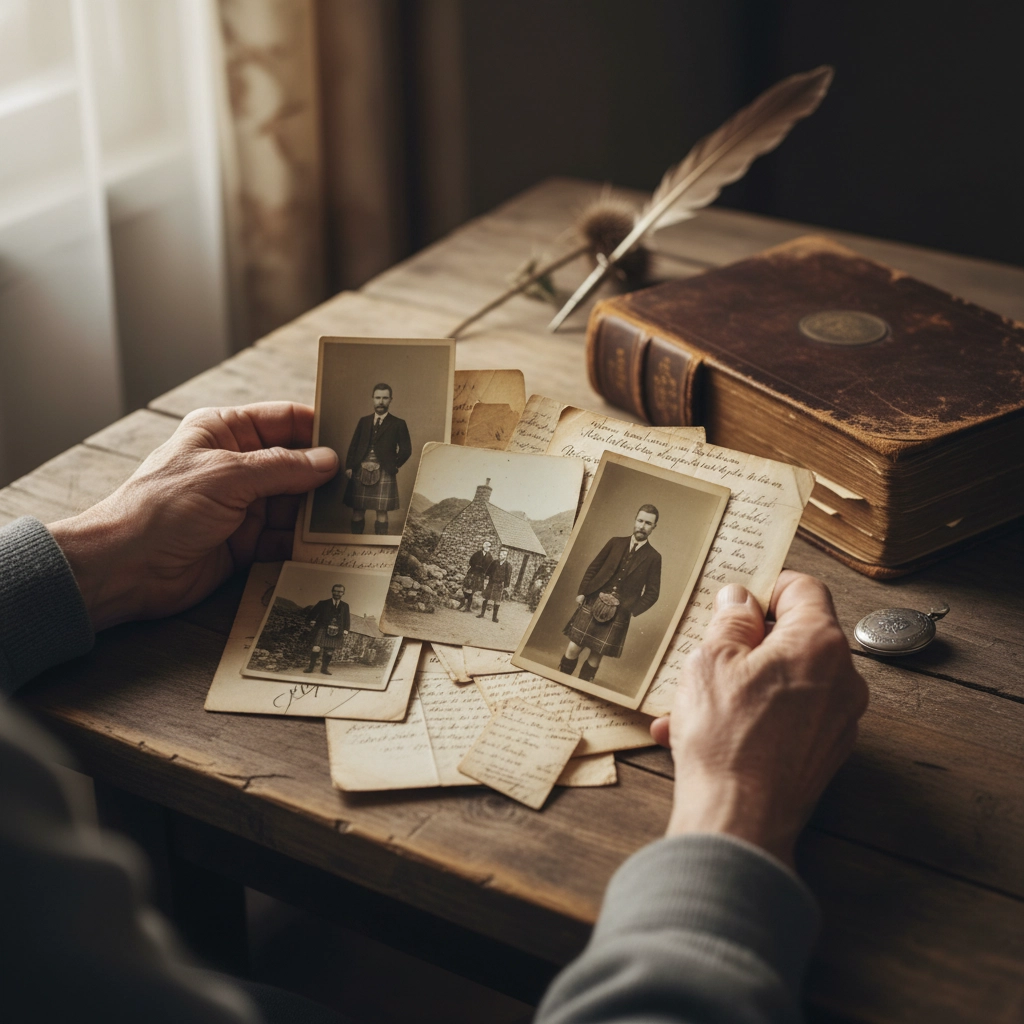
Mistake #4: Copying and Pasting from Online Family Trees
Online family trees can seem like genealogical treasure troves, offering seemingly complete lineages that would take you years to research independently. But here's the catch: many of these trees are built on shaky foundations, with researchers copying information from other trees without verification.
It's the genealogical equivalent of a house of cards. If the original researcher made an error connecting two generations, every person attached to that lineage becomes suspect. You might unknowingly add hundreds of unrelated people to your family tree, creating an impressive but entirely fictional Scottish heritage.
The Fix: Treat online family trees as research hints, not definitive sources. Before adding anyone to your tree based on someone else's research, verify the connection through original records. Look for birth certificates, death certificates, census records, and parish registers that support the claimed relationships. It takes more time, but you'll build a family tree based on solid evidence rather than wishful thinking.
Mistake #5: Ignoring the Paper Trail
Picture this: you've spent hours researching and finally discover a crucial piece of information about your Scottish ancestor. Six months later, you want to verify that detail or show it to a cousin, but you can't remember where you found it. Without proper source documentation, your research becomes a genealogical ghost story: interesting but impossible to substantiate.
This mistake is particularly costly in Scottish research, where records can be scattered across multiple repositories and online databases. That parish register entry you found last year might be difficult to locate again without proper citation.
The Fix: Develop a source citation habit from day one. For every piece of information you add to your family tree, record exactly where you found it: the specific website, database, document name, page number, and date you accessed it. Use genealogy software that makes citation easy, or create a simple system in a notebook. Future you (and your family members) will thank you for this diligence.

Mistake #6: Limiting Yourself to the Usual Suspects
Many genealogists build their entire Scottish family history using only census records and vital statistics (births, marriages, deaths). While these sources provide excellent skeletal information, they're like reading only the chapter headings of your ancestors' life stories: you miss all the fascinating details that make them real people.
Scottish ancestors led rich, complex lives that extended far beyond the basic facts captured in census returns. They served in the military, emigrated to new countries, joined churches, owned property, wrote wills, appeared in newspapers, and left traces in dozens of other record types that can flesh out their stories.
The Fix: Expand your research toolkit to include kirk session records, military service records, passenger lists, newspaper archives, probate records, land records, tax rolls, and cemetery records. Each record type reveals different aspects of your ancestors' lives and can provide breakthrough discoveries. Don't just document that your ancestor lived: discover how they lived.
Mistake #7: Underestimating Scottish-Specific Research Challenges
Scottish genealogy presents unique obstacles that can derail researchers who aren't prepared for them. Parish registers might have gaps due to wars, religious conflicts, or simple neglect. Non-conformist ancestors might not appear in Church of Scotland records at all. Place names can be frustratingly vague: "Scotland" as a birthplace isn't particularly helpful when you're trying to narrow down research locations.
Additionally, Scottish naming patterns, illegitimacy records, and clan relationships create layers of complexity that don't exist in other genealogical traditions. Many researchers get discouraged when they encounter these challenges without understanding they're normal parts of Scottish research.
The Fix: Educate yourself about Scottish history, geography, and record-keeping practices. Join Scottish genealogy groups and forums where experienced researchers share knowledge and strategies. Learn about Scottish naming patterns: many families followed traditions like naming the first son after the paternal grandfather and the first daughter after the maternal grandmother. Understanding these patterns can help you predict relationships and identify missing records.
When you encounter vague location information, research your ancestor's siblings and extended family: later records might provide more specific birthplace details. Use gazetteer resources to understand Scottish geography and identify small villages that might not appear on modern maps.
Moving Forward with Confidence
Remember, encountering these challenges doesn't make you a poor researcher: it makes you a normal one! Every genealogist working with Scottish ancestry faces these same obstacles. The difference between those who succeed and those who get frustrated lies in recognising these common pitfalls and developing strategies to overcome them.
Your Scottish ancestors lived remarkable lives filled with courage, hardship, joy, and perseverance. They deserve to have their stories told accurately and completely. By avoiding these seven common mistakes, you're not just improving your research skills: you're honouring their memory and preserving their legacy for future generations.
Scottish genealogy is a journey, not a sprint. Each record you discover, each connection you verify, and each story you uncover brings you closer to understanding not just where you came from, but who your ancestors really were. And that understanding: that deep connection to your Scottish heritage: makes every challenging research moment worth the effort.
Ready to dive deeper into your Scottish ancestry research? Visit How We Got Here Genealogy Services to discover how professional guidance can help you navigate the unique challenges of Scottish genealogy and uncover the remarkable stories waiting in your family tree.