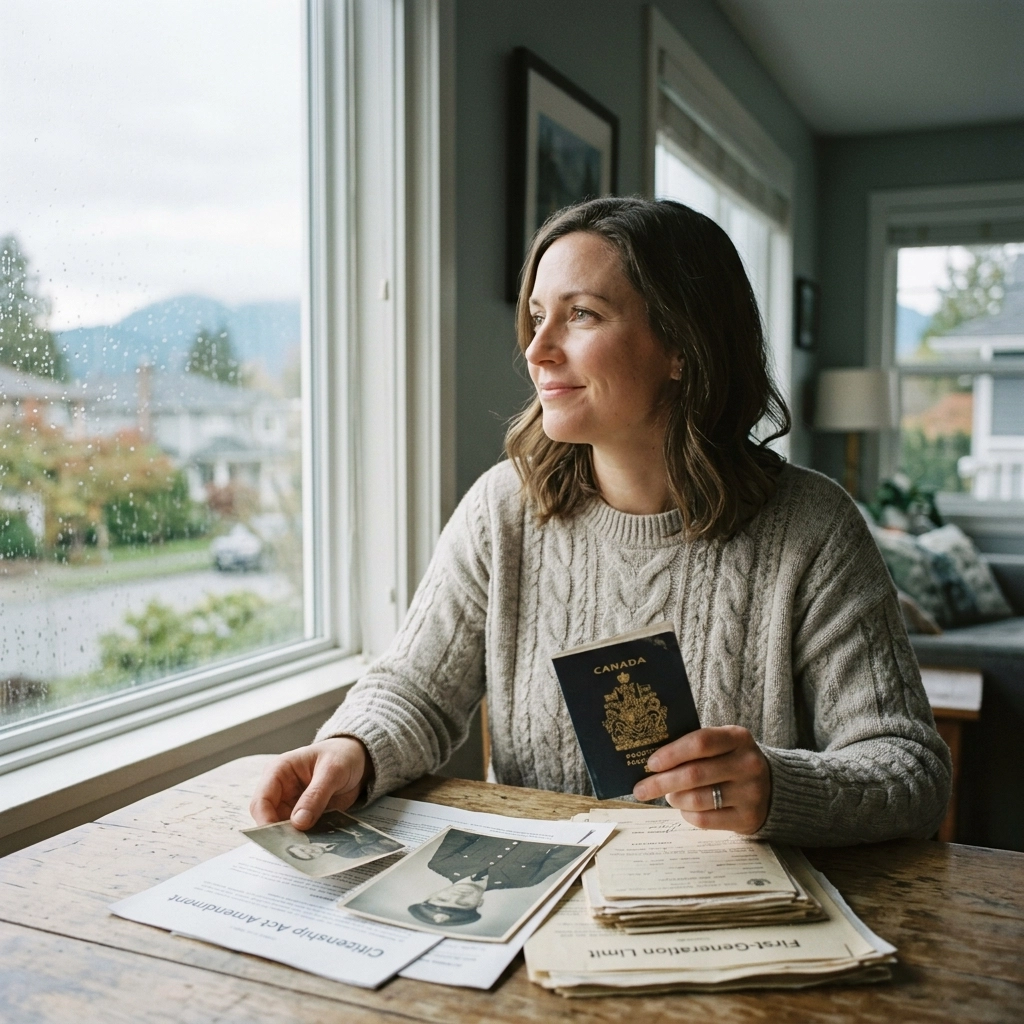

If you’ve been told “sorry, the line stops with you,” this is the update you need to see.
Bill C-3 is the major shift many families have been waiting for. For years, the first-generation limit blocked countless people from claiming or passing on Canadian citizenship, even when their family connection was clear as day. Now the rules have changed, and that old brick wall may no longer apply to you.
That means this is no longer just an interesting family history detail. It could be your opening to reclaim Canadian citizenship and move forward with proof, paperwork, and a real plan.
What Bill C-3 Changes Right Now
Here’s the short version: Bill C-3 removes the old first-generation limit that cut off citizenship by descent for many families born abroad.
In plain English, that means people who were previously shut out may now have a path forward.
This is especially important if:
- your parent or grandparent was Canadian
- you were born outside Canada and were told you did not qualify
- your own children were blocked because citizenship could not pass beyond the first generation born abroad
- you’ve delayed applying because the rules seemed stacked against you
For many families, this is the difference between “not eligible” and “it’s time to take another look”.

The Fastest Way to Check If You May Qualify
Let’s keep this simple. If you want to move quickly, start here.
Step 1: Identify your Canadian connection
Ask yourself:
- Was your parent born in Canada?
- Was your grandparent born in Canada?
- Did a parent become a Canadian citizen before you were born?
- Were you or your children previously denied because of the first-generation limit?
If you answered yes to any of these, you may have a strong reason to investigate further.
Step 2: Build a basic document list
Before you do anything else, gather the records that connect you to your Canadian line. Start with:
- your own birth certificate
- your parent’s birth certificate
- your grandparent’s birth, marriage, or death records
- any citizenship certificates, passports, or immigration records already in the family
- legal name-change documents, if applicable
Don’t panic if your file is messy. Most family history files are. The goal is to create a starting point, not a perfect archive on day one.
Step 3: Watch for the old blocker
If the reason you stopped before was the first-generation limit, that is exactly why Bill C-3 matters.
A lot of people gave up because they were told the line ended there. That advice may now be outdated. What looked like a dead end could now be your reopening.

The Key Requirement You Still Need to Understand
Bill C-3 is a big win, but here’s the crucial detail: the 1,095-day rule depends on when the child was born abroad.
The effective date cutoff: 15 December 2025
This date matters a lot.
- If you were born abroad before 15 December 2025, you are generally exempt from the 1,095-day rule, and your citizenship is typically restored automatically under the new rules.
- If you were born abroad on or after 15 December 2025, the Canadian parent must meet the substantial connection test in order to pass on citizenship beyond the first generation born abroad.
That’s the big dividing line. For many families, this is the difference between an automatic restoration and a proof-heavy application.
What “substantial connection” actually means
In practical terms, “substantial connection” means the Canadian parent must show at least 1,095 days of cumulative physical presence in Canada before the child’s birth or adoption.
That time:
- does not need to be consecutive
- can be added up across different periods of the parent’s life
- must be backed up with real evidence
So this is not about guessing or relying on family lore. It’s about building a paper trail that proves time spent in Canada.
What evidence may be needed
To prove that substantial connection, families often need records such as:
- tax filings
- school transcripts
- CBSA travel history
- provincial records
- employment records
- leases or property records
- health coverage records
- other documents showing physical presence in Canada over time
If your case falls after the cutoff date, this evidence can make or break the claim.
If you’re missing pieces, don’t assume you’re stuck. This is exactly where good genealogy research becomes your secret weapon.
What You Can Do Today to Start the Process
If you want momentum, here are the immediate actions to take:
- Write down your line of descent from you back to the Canadian-born ancestor
- Collect every family document already in your house before ordering anything new
- Make a list of missing records so you know what has to be found
- Note any previous refusals or eligibility concerns tied to the first-generation limit
- Book expert help early if your case involves gaps, name changes, border births, adoption, or multiple countries
The biggest mistake people make is waiting until they feel “ready”. Ready comes from action. Start with the paper trail you have.
How We Help You Move Faster
At How We Got Here Genealogy Services, we help you turn a vague family story into usable evidence.
That means we can help you:
- trace the right family line
- locate hard-to-find records
- organise documents into a clearer proof package
- identify weak spots before they slow you down
- research and gather evidence to prove a substantial connection to Canada
- build a stronger case when your eligibility depends on historical records
Whether you’re dealing with an unregistered birth, a missing marriage record, residency questions, or an ancestor whose paper trail zigzags across borders, we work with you to make the process clearer and less overwhelming.
If you need to show 1,095 cumulative days in Canada, we can help track down the records that support that claim, including tax filings, school transcripts, CBSA travel history, and provincial records. When the rules get technical, solid research is what keeps your application moving.

Don’t Just Wonder If You Qualify. Find Out.
This is the moment to stop guessing.
If Bill C-3 removes the barrier that blocked your family before, the smartest move is to check your eligibility now, gather your evidence, and start building your case properly.
Ready to find out if Bill C-3 opens the door for you?
Book your free consultation and let’s look at your family line together:
Click here to see if you qualify and book your free consultation!
If you want to strengthen your research skills at the same time, explore our practical courses and learn how to document your family history like a pro.
Let’s get to work. Because every family has a story… and sometimes the next record you find changes everything.

Uncovering your family history is a journey, not a sprint. Every record and every story brings you closer to the truth of how you got here.
Brian Nash
Chief Genealogist and Owner, How We Got Here Genealogy Services
For more information on Canadian history and research tools, check out our Post Archive or explore our courses to learn how to research like a pro.